Learn More & FAQs

Logo for Lead-Safe Columbus featuring a house with a water faucet and flowing water, with the text “Lead-Safe Columbus” and the tagline “One pipe at a time.”


NEW! Separate from the scheduled replacement program, the Lead Elimination Assistance Program (LEAP) helps homeowners replace lead or galvanized water service lines proactively or if they break. Click here to learn about LEAP.

Like many cities across the U.S., some water service lines in Columbus are more than a century old. Due to our exceptional water treatment, these service lines have lasted beyond their expected life. Approximately 20% of City of Columbus water service lines need to be replaced because they may still contain lead components. Since 1996, Columbus has replaced all service lines with lead components as we've encountered them. 

We now have a federal mandate to proactively replace private and public lead and galvanized lines by 2037. In 2025, Columbus will start going street by street to replace these older lines. The Lead Service Line Replacement (LSLR) Program proactively removes public and private water service lines made of lead and galvanized steel. 

Text reading “A Proactive Approach to Protecting Water Quality” and “Lead Service Line Replacement Program” over an image of water flowing from a faucet into a glass.

What you need to know:

Is there lead in Columbus' water? No lead is detected in the water leaving Columbus' water treatment plants. Through our partnership with Columbus Public Health, we can confidently say the main source of lead exposure in Columbus is not tap water, it's lead paint.

  • Only lead and galvanized water service lines will be replaced.
  • Galvanized water service lines can absorb lead particles and have lasted well beyond their expected life (50-70 years).
  • Columbus effectively treats drinking water to prevent lead from entering water through plumbing materials. 
  • Drinking water is not the main source of lead exposure in Columbus; paint is. The city has multiple programs currently addressing lead paint. 
  • The city has been removing lead water service lines since 1996 during maintenance and emergency repairs. 
  • Columbus has not allowed the installation of lead and galvanized water service lines since December 1963. 
  • Residents will be notified when service line replacement is scheduled for their area.
  • A work agreement must be signed by the property owner to participate in the program.


FREQUENTLY ASKED QUESTIONS

What is a water service line?

Your water service line is the pipe that connects your home or business to the public water main. The water service line is divided into two sections; a city-owned part and a customer-owned part. These parts can be made of different materials. You can see the materials of the city and customer portions in our inventory. Click to view the city inventory of service line materials.

Diagram showing a water service line running from the water main to a home. The utility-owned portion extends from the water main to the curb stop. The customer-owned portion extends from the curb stop to the water meter inside the home.

How much will replacement cost?

During scheduled replacement, Columbus intends to cover the cost of a one-time replacement of eligible water service lines as long as funding remains. Replacement cost ranges from $6,000-$10,000 per property. New water service lines add value to your home. 

Outside scheduled replacement, homeowners may use the Lead Elimination Assistance Program (LEAP) to replace their lead or galvanized water service line proactively or if broken. LEAP is a no-interest construction loan with deferred repayment, secured as a mortgage against the property. The loan is paid when the property is sold, refinanced, or in one lump sum within 99 years.

What will be replaced?

Public and private side lead and galvanized water service lines will be replaced. Lead-free copper will replace lead and galvanized lines. We can not replace any lead hazards in the home, however, the Department of Development or Columbus Public Health may be able to assist you with other lead sources in your home. 

Learn more about eliminating other sources of lead

Use the guide below to help identify what your water service line is made of at home

Guide for identifying water service line materials. Test the first piece of pipe coming through the wall or floor. Plastic feels like plastic and a magnet will not stick. Ductile iron is typically found in commercial buildings or large campuses and a magnet will stick. Lead is shiny silver, easy to scratch, and a magnet will not stick; it is eligible for replacement. Galvanized pipe is dull gray, hard to scratch, and a magnet will stick; it is eligible for replacement. Copper is penny-colored and a magnet will not stick

How will my water service line be replaced?

There are two replacement techniques designed to minimize digging and disruption to surrounding property; directional boring and pull-through techniques. In areas where the current line has interference, such as a tree, it may be possible to move around the object with directional boring. Water service lines will be installed without digging large trenches unless the contractor determines trenchless methods are not possible. Click to see examples of replacement techniques. 

What is a galvanized water service line, and why does it need replaced?

Galvanized water service lines are usually steel pipes coated with zinc to protect it from rust and corrosion. If downstream from a lead water service line, galvanized lines may absorb lead particles. These may be referred to as "galvanized requiring replacement lines." Old galvanized lines are prone to leaks. Replacing galvanized lines may conserve water and improve water pressure. Columbus will be replacing all galvanized water service lines. 

I got a notice on my water bill that I have a lead or galvanized line. What does that mean?

The Columbus Division of Water is required to send out a notice of water service line material every year. This is not a notice of any sort of water quality concern. The existence of a lead or galvanized service line does not mean that lead is present in your drinking water. The City of Columbus’ current treatment practices significantly reduce the possibility of exposure to lead. 

If you received a notice that you have a water service line made of lead or galvanized requiring replacement (GRR), then our records indicate that some portion of the line (the city-owned side, the customer-owned side, or both) contains lead or galvanized material. Therefore, the material of the pipe you see coming into your home, may be different from the material on the notice you received. 

To see the material of the public and privately owned portion of the water line, search your address in our inventory.

We test the water for lead. View the latest testing results in the 2025 water quality report.   

Please visit "Understanding Lead and Water" about best practices you can follow if you have a lead or galvanized line.
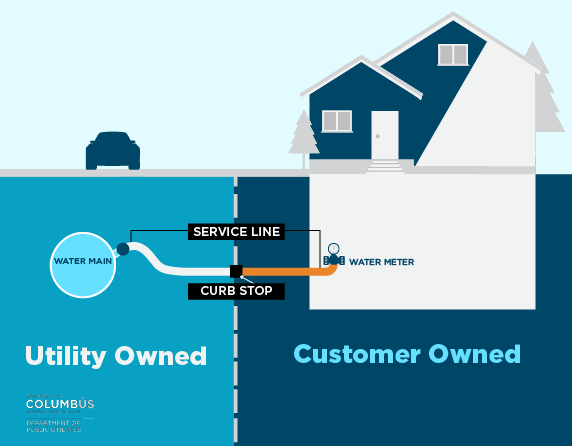
Diagram showing a water service line running from the water main to a home. The utility-owned portion extends from the water main to the curb stop. The customer-owned portion extends from the curb stop to the water meter inside the home.

What material will you replace the lines with?

Lead and galvanized lines will be replaced with lead-free copper.

What if I live outside the City of Columbus?

Every public water system in the United States that has at least one lead water service line is required to replace them. We are working on replacement solutions for our customers living outside Columbus. If you currently live outside Columbus City limits, your local municipality will notify you when you are eligible for replacement.

View this map of Columbus' boundaries to find which municipality you live in.

Will the city replace damages to my property as a result of construction?

Yes. If it is determined the damage was done by the construction crew, they will be responsible for repairing the damage. Repairs will be restored to the condition before replacement. Inspectors will document property conditions before and after replacement. 

Will my water be shut off during replacement?

Yes, water will be shut off during the replacement process. Please prepare for water loss of 6-8 hours. The city will notify all customers before water is shut off by tagging your door, email, or text. Other utilities, such as electricity, will remain on.

Does my home or building have a lead or galvanized water service line?

Graphic showing a blurred street map with location markers. Text explains that the City is mapping all water service line materials and residents can search their address in the inventory to view the material on the public or private side of their property.If your property is within the City of Columbus and your water service line was installed after 1964, then you likely do not have a lead or galvanized water service line. A galvanized line is made of steel. If a galvanized water line is downstream of a lead line, it may have absorbed lead particles and must be replaced. Search your address in our service line inventory to check the material of public and private side water service lines.

Is your line "unknown?"

Photo of an indoor water meter and pipes. A red arrow points to the first piece of water service line coming out of the wall, showing where to test the pipe material


Take a picture of your water service line and share it with us through a quick online survey submission form linked here. Please take a picture with good lighting of the very first piece of material coming out of your wall or floor.

HAVE QUESTIONS OR NEED ASSISTANCE?
CALL 614-645-6725
EMAIL LEADSAFELINES@COLUMBUS.GOV
OR CLICK HERE TO OPEN A SUPPORT TICKET.


Have you already replaced your water service line?

Notify us if you have recently replaced your water service line. Submit the new material through the online service line material form linked here, or email waterquality@columbus.gov.